

Flat Circle tracks creative uses of LLMs in hedge funds. Join hundreds of PMs, analysts and engineers reading each week:
New feature: Idea Files
The most popular all-time links in this newsletter are:
Daily macro report based on Polymarket odds changes (@pathikrit_wrick)
Evasion detection in earnings call transcripts (arXiv)
Say-do score: identifying whether past CEO promises bore out (@dahu7744)
Scoring the expertise and track record of every CEO (@FundamentalEdge)
Identifying discrepancies between press releases and transcripts (InfoArb)
Investors want creative ways to generate new insights by using agents to process unstructured info on a large scale.
The problem is ideas aren’t enough. Every reader still has to do the same work building the agents, troubleshooting, QAing and analyzing the data before they know whether it will be useful in their process.
Starting today, we’re including “idea files” with certain use cases. An idea file is a detailed prompt you can use to recreate and customize an agent use case in Codex or Claude Code/Cowork (for more on idea files see here). We’ll host the prompt as a GitHub Gist, and include example data as well.
Using an idea file is simple: simply paste the link into your Codex or Claude along with any modifications you’d like and hit submit.
We hope this will improve the newsletter and make it easier to include these use cases into your process.
Creative use cases with Idea Files
Track what brands different models are recommending for top consumer categories (Original Idea: r/ClaudeAI, Idea File, Example Dataset)
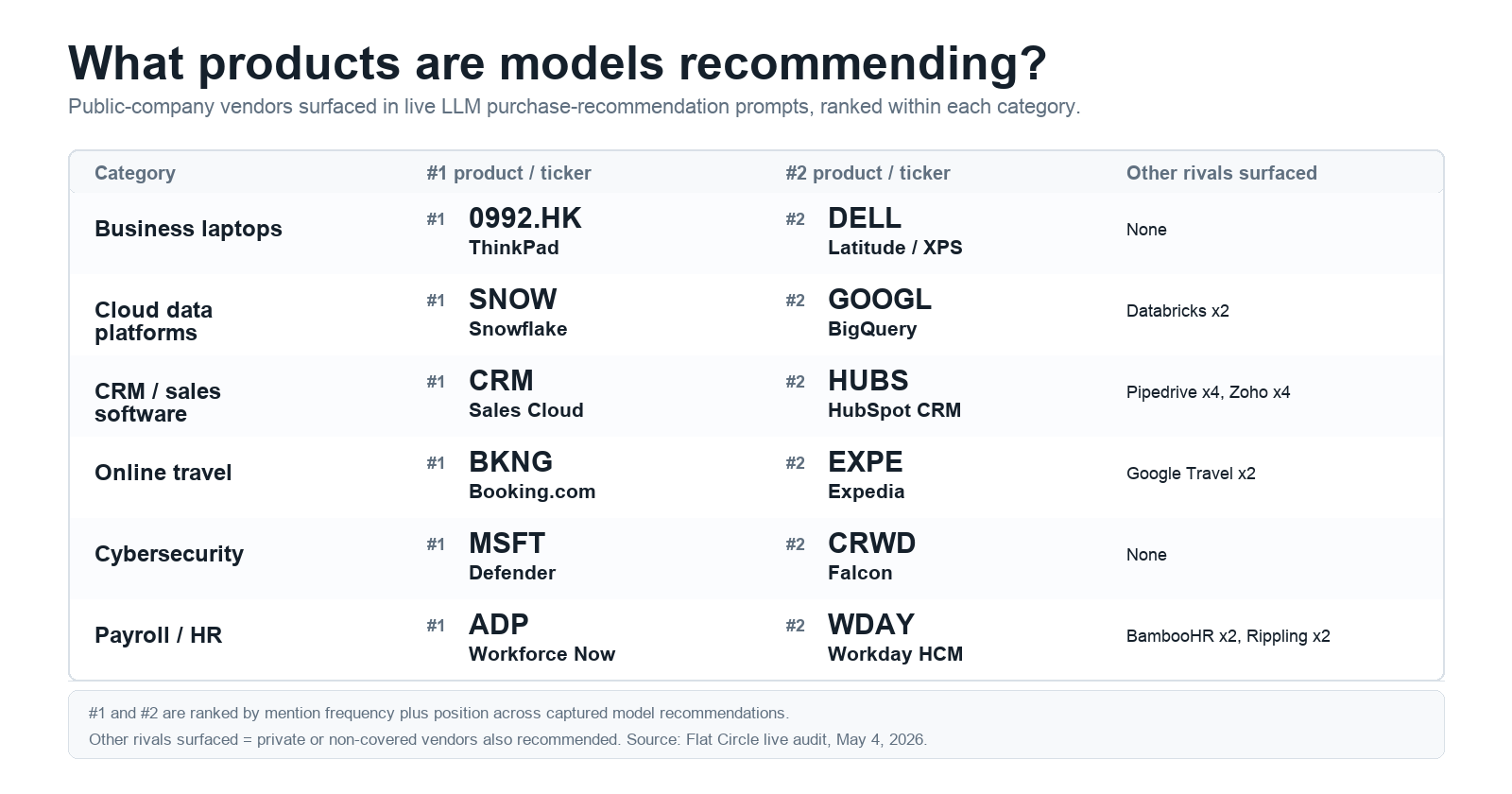
Recreate and customize using our idea file
Compare recent earnings transcripts to flag ‘lexical pivots’ by management (Original Idea: Uncle Equity, Idea File, Example Dataset)
window one read every Q12026 earnings transcript from every company in North American consumer discretionary above 2 billion summarized structurally flag any company where tone on pricing power inventory or consumer health materially shifted from Q42025... By 7:41 AM, Claude flags a mid-cap specialty retailer: management pivoted from ‘robust’ to ‘resilient’ quarter-over-quarter, forward-guidance answers dropped from seven to two.
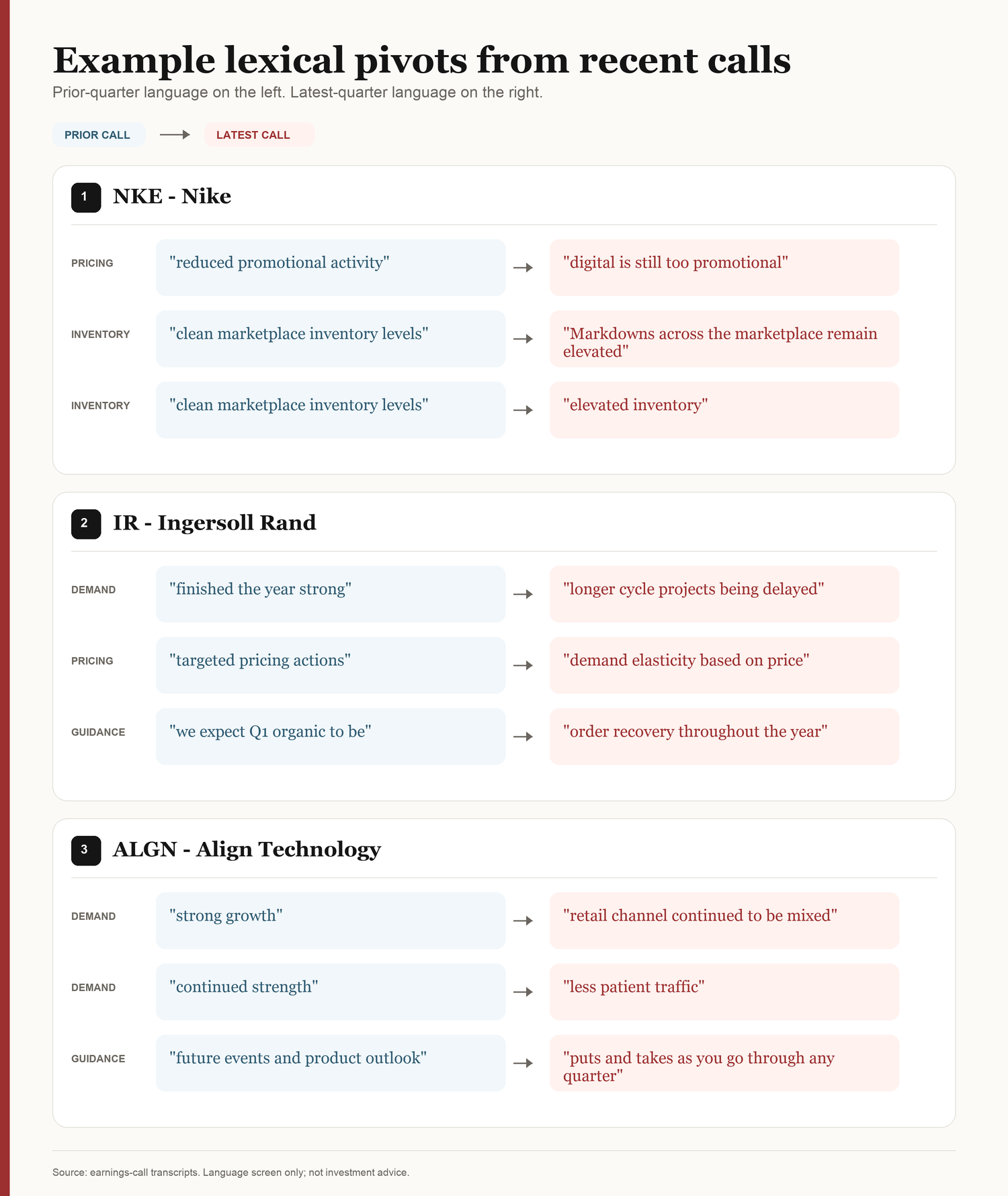
Recreate and customize using our idea file
Creative use cases from newsletters
Use an agent to score the distance between a company’s “AI rhetoric” and its concrete financial KPIs - for example, mapping claimed efficiency gains against actual compensation expenses and headcount data. Companies whose rhetoric matched their financial reality generated a 41% 12-month return and significantly outperformed those with high discrepancy (Terminal-X.ai)
How to build a “capital allocation scorer” - uses Claude to map five years of historical cashflow statements to management discussion sections, then traces the outcomes of buybacks, M&A and dividend decisions (AI Investing Lab)
How to build a real estate deal pipeline that ingests broker emails, offering memoranda and CoStar exports (AI Consulting Network).
Last-100-declined-deals log with rationale. This is the gold standard input. The model learns far more from “why did we pass” than from “what do we like.”
BlackRock built RockAI, a vibe coding tool with data access and convernance, for its employees to vibecode safely (WSJ, thank you to Matt Robinson)
Creative use cases mentioned on X
Ex-Meta AI founder shares a system to turn podcasts into a knowledge base (@omarsar0)
The agent (Opus 4.7) spots important insights, does deep analysis, and generates thought-provoking observations that really get me curious to research further. All the research goes into a self-improving wiki for later use by any of my agents.
Investor on X shares prompt to grade management on say-do score, transparency, discipline and shareholder alignment (@kaizen_investor)
An investor recommends feeding Claude “The Visual Display of Quantitative Information” by Edward Tufte before prompting it to design charts (@ClarkSquareCapital)
IR teams may be building AI simulators of their top sell-side analysts to stress test their earnings call scripts (@rchikballapur)
An investor recommends thinking of agents as your clones that can be delegated to perform tasks you’d otherwise not prioritize (@FundamentalEdge)
> A clone that listens to every public statement from every competitor, whether on an earnings call, investor conference or podcast, pinging you with relevant read-thoughts
> A clone that gives you the devil's advocate on every position, encoded with your own custom thesis creep prevention checklist
> A clone that does a deep proxy/form-4 analyses on equity incentives for all of your management teams
> A clone that helps you analyze the buy-side whisper on every name heading into print
Creative use cases mentioned in papers
New paper analyzing 16 years of mutual fund outlook reports (Princeton.edu)
Using an LLM-based approach, we extract each fund’s outlook for the domestic equity market and decompose it into beliefs about macroeconomic fundamentals, beliefs about government policy, and a residual component that we interpret as fund sentiment. This decomposition yields a clear hierarchy of information content: funds’ policy beliefs significantly predict subsequent market returns, while beliefs about macro fundamentals and sentiment offer little or no forecasting value.
HBS paper reveals models are biased toward certain business strategies over others (HBR.org). What will be the implication of this as LLMs increasingly become thought partners for investors and executives.

Requesting your feedback
A few investors have shared a challenge around assessing whether an insight generated by an agent represents a variant perspective from consensus. Is this a problem for you? We are working on a solution and would love to discuss - please reply or reach out.
Follow for more creative agent use cases
If you would like to discuss incorporating agents into your research process, reply to this email or reach out via X or LinkedIn.